
Artist Natale Adgnot


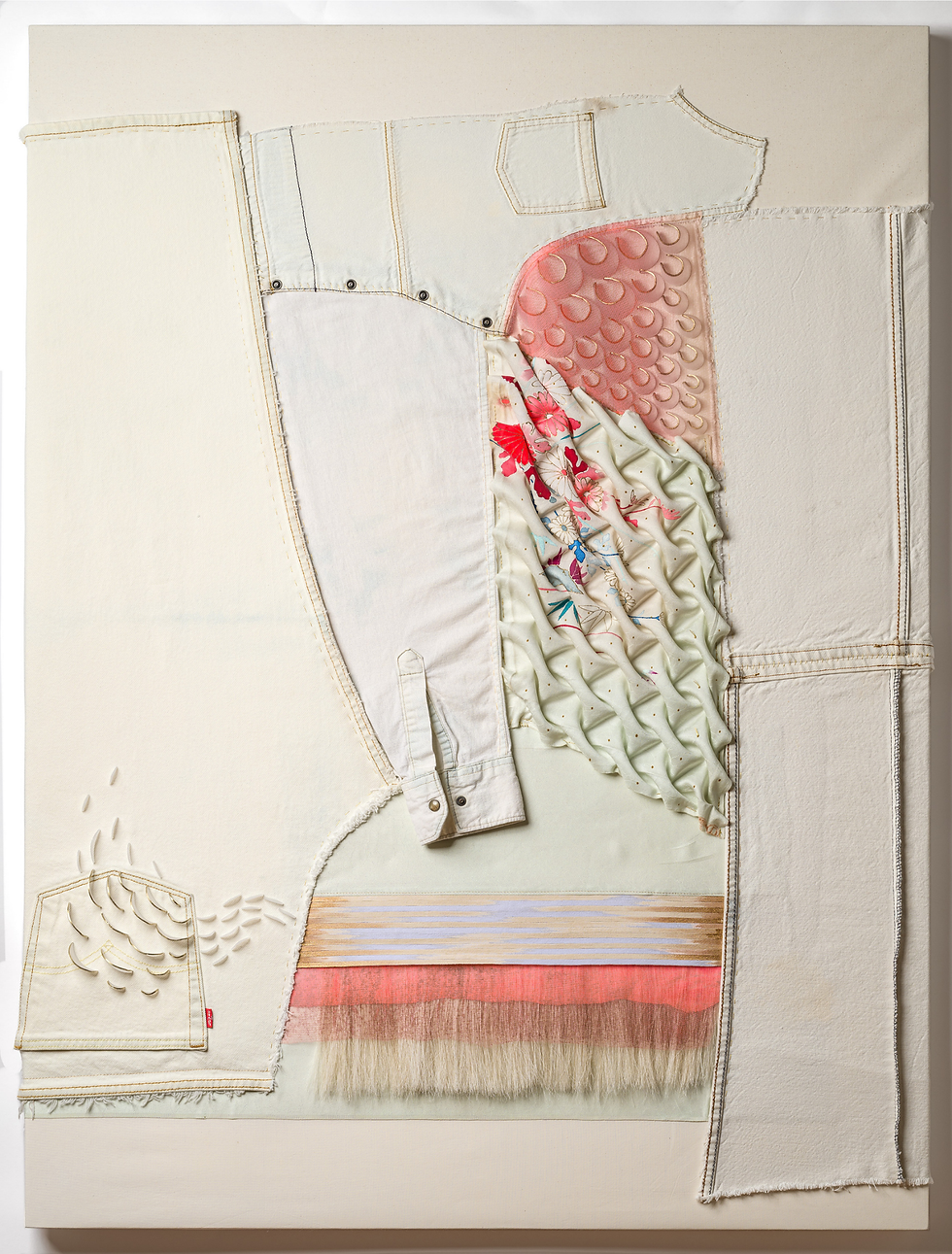
Natale Adgnot is a sculptor who combines garments, thermoplastic, and various fibers to create abstract soft sculptures and wall panels. Focusing on the connotations of each material, she layers high- and low-brow elements to tell the cross-class and intercultural story of her life.
The daughter of a horse trainer, Adgnot was raised in Texas. She earned a BFA there before immigrating to France in her 20s, eventually becoming a dual American/French citizen. While living in Paris, she studied fashion. Originally a painter, her experience making garments for haute couture runways led her to focus on sculpture. Later, while living in Japan, she began using thermoplastic (an artist-grade shrink plastic) to work three-dimensionally. Her mediums have expanded to include textiles, horsehair, and other materials that signify all of these places.
Adgnot has been featured in solo and two-person exhibitions in the U.S., Canada, and Japan. Group exhibitions include SPRING/BREAK, “Black & White” at BWAC juried by Jenée-Daria Strand of the Brooklyn Museum, and “I was not born alone” at Transmitter. Her work has appeared in Hyperallergic, Whitehot Magazine, Art Spiel, ArtForum, The Japan Times, and more. Adgnot is the founder/director of N/A Project Space and a co-director of Underdonk. She lives and works in Brooklyn and New Paltz, New York.

"I use abstract sculpture to explore bias and faulty perception as byproducts of a monocultural upbringing. At its core, my practice is a dismantling of the dogma of my childhood. The daughter of a horse trainer in Texas, I was raised with little awareness of the world beyond my town and church. My exposure to different cultures and viewpoints came later while living in France and Japan. A metaphor for my yearning to bridge cultural gaps in understanding, my work combines materials that tell my life story. Western-style clothing and horsehair represent my childhood in Texas. Cotton muslin, a fashion prototyping staple, is representative of my decade living in Paris and working in couture. Kimono silk and gold thread (deployed as a stand-in for the gold lacquer used in kintsugi) are a nod to the three years I spent living in Japan. And finally, the feather-like protrusions, horse hooves, and other shapes I affix to many of my sculptures are made of thermoplastic, a versatile and shape-shifting material that represents my current life in New York City where people are free to take many forms."

Tell us a little about yourself (where you are from) and your background in the arts.
Where I’m from and where I’ve lived are key parts of my art practice. Like a lot of artists, I came to this career via a long and winding path that circled the art life before finally leading to it.
Even though I always wanted to be an artist, I started out as a designer. I grew up in Texas in a conservative family where my brother and I were the first to graduate from college. My parents were skeptical of my desire to study art so they encouraged me to get a design degree. I was a graphic and web designer for years.
I moved to France in my 20s where I eventually went back to school to study fashion. Then I had the incredible fortune to work in haute couture in Paris, helping to make crazy sculptural pieces for the runway. I didn’t realize it at the time, but that’s where I cut my teeth as a sculptor. It would take another experience as an immigrant before I would finally decide on sculpture as my main focus.
After nearly a decade in France, I moved to New York City in 2009 and then Tokyo in 2015. When I first moved to Japan, I was making large paintings. In 2016, it started to dawn on me that large artworks were hard for people to fit into their small apartments. So I shifted gears and began making small sculptural works that could sit on a bookshelf or tabletop. By the time we moved back to NYC in 2018, I was devoted to sculpture. Over the last few years, I’ve found my way back to the fabric of my fashion days, only this time, I’m using reclaimed kimono silk, Wrangler cowboy snap shirts, and lots of denim to weave together the narrative of my life story.
What kind of work are you currently making?
I'm making several kinds of work this year, all with the same library of materials: reclaimed country-western garments, vintage kimonos, cotton muslin, tulle, horsehair, and painted thermoplastic. There are three main exhibitions I’m focused on for the year, and each one requires a slightly different approach.
This month, I’m finishing some Japanese scroll-inspired pieces for the 12th annual Light Art Festival that takes place next month at a historic samurai school building (https://www.japan-guide.com/e/e4356.html) in Iga, Japan. The traditional scroll (kakejiku) has a specific set of proportions which I’m following while substituting my own materials for the usual silk and paper. For example, I’m framing the central illustration with parts of a snap shirt and I’m adding leather fringe to the bottom of the scroll.
The work for the other two presentations will be much more three-dimensional like the rest of my Saddle Couturage series. These new soft sculptures will use shapes from a saddlemaking pattern like the first ones did, but they might feel pretty different because they will reflect the bilateral symmetry of the human form.
What is a day like in the studio for you?
I'm lucky to be in the studio full time (unless you count the other hats I wear as a curator and as the owner/director of an art space in upstate New York). I arrive at the studio in the morning and try to knock out all of the computer tasks before lunch so I can focus on making things with my hands for the rest of the day. Depending on the projects in progress, I might spend time deconstructing vintage kimonos, painting or dip-dyeing fabrics, or sketching out diagrams of artworks I have ideas for.
Sometimes I’m painting large sheets of thermoplastic that will be cut into shapes that are ready for shrinking and molding around objects I keep in the studio for the purpose of shaping the plastic as it cools. For this series, the horse hooves you see on many artworks are made in this way. They start as banana-shaped pieces of painted thermoplastic. When they come out of the oven, I quickly wrap them around a paper-clay model of a horse hoof that I made and when they are fully cooled, I trim the edges with gold enamel.
My favorite part of the process is the hand sewing. Once all the textile components are cut out and I know what I want to sew where, I settle in with my gold thread and get lost in the meditative repetition of stitching it all together.
What are you looking at right now and/or reading?
I spend a lot of time looking at other artists' work online and at galleries in the city. This year, I'm curating several exhibitions for spaces both in NYC and upstate. So that has given me the opportunity to really dig into the practices of artists I'm considering for my shows. I'm finding that artists' statements are so critical for appreciating the artworks they create. The language provides me with new jumping off points to discover other artists, too, and I enjoy going down those rabbit holes.
When I'm not looking at art, I'm rewatching (and seeing for the first time!) some of the best films of the 1970s, 80s and 90s that I missed when I was a kid. Taxi Driver, One Flew Over the Cuckoo's Nest, and The Stepford Wives still seem sadly relevant 50 years later. David Lynch's delightfully weird world has been fun to rediscover with my cinephile teenager.
I'm also reading Demon Copperhead by Barbara Kingsolver, which is set in Appalachia. The characters all recall real people I knew growing up in Texas.
Where can we find more of your work? (ex. website/insta/gallery/upcoming shows)
Website: www.nataleadgnot.com
Instagram: https://www.instagram.com/natale_adgnot



Comments