
Artist Danielle Mysliwiec

Updated: Dec 11, 2025

Danielle Mysliwiec holds a BA from Wesleyan University and an MFA from Hunter College. Mysliwiec has participated in exhibitions at Asya Geisberg Gallery, Good Naked, Brintz+County, Untitled Art Fair, The Peale Museum, McKenzie Fine Art, Transmitter, Mixed Greens, Novella, Vox Populi, Kent State University, and The Center for Craft among other venues.
Mysliwiec’s paintings have been featured and reviewed in publications including The Brooklyn Rail, Maake Magazine, New American Paintings, Inertia, Art F City, The Washington Post, B’more Art, and The New York Times. She has been awarded fully funded residencies to the Tides Institute & Museum, Long Meadow Art Residency, the Surf Point Foundation, and Vermont Studio Center, as well as grants from the DC Commission on Arts & Humanities, the Arts & Humanities Commission of Montgomery County, and the Maryland State Arts Council.
Mysliwiec is currently on the board of Interlude Artist Residency, a residency supporting parent artists. She is an Associate Professor of Art at American University in Washington, DC.

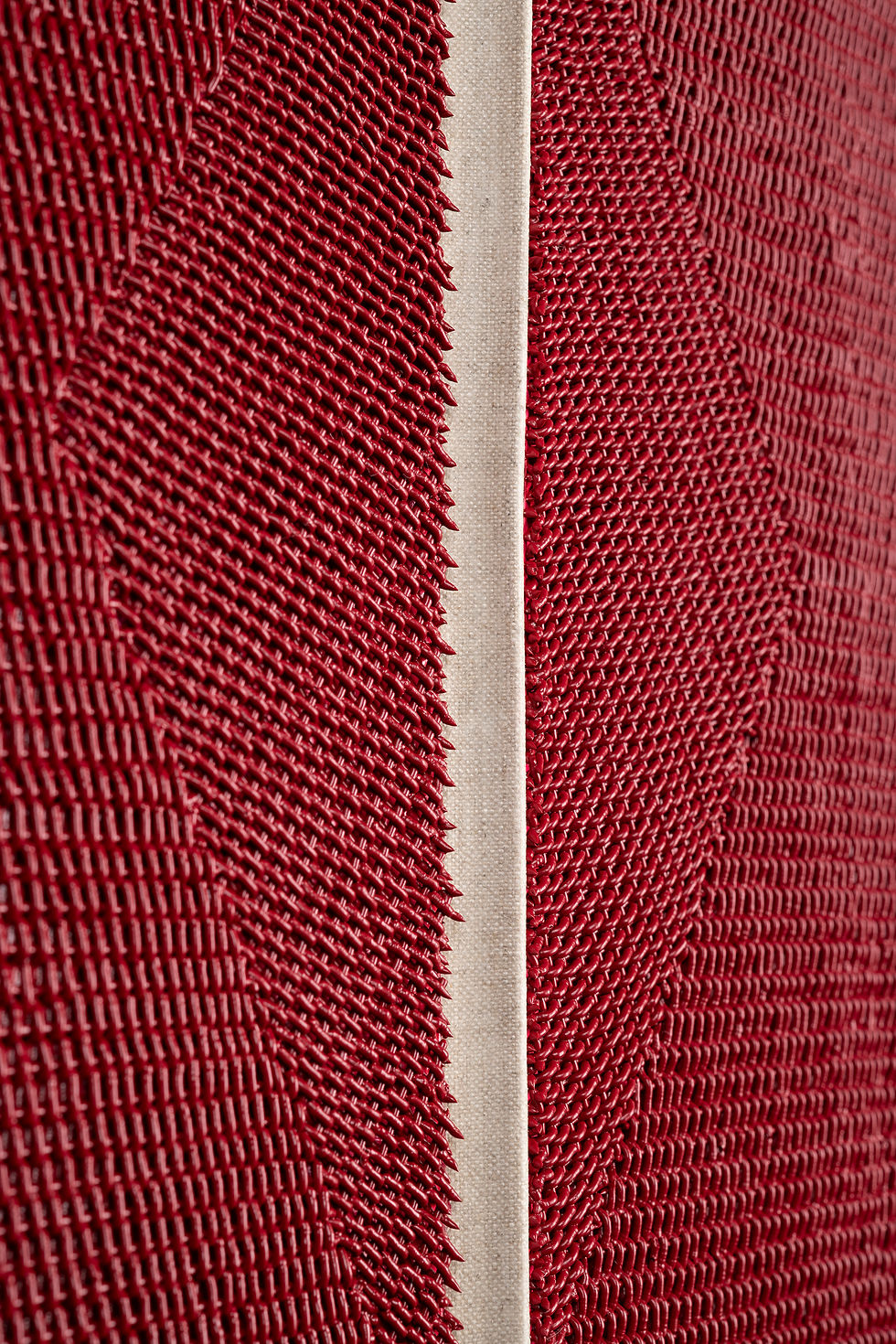
"I combine the pliable properties of oil paint with the rigorous structure of weaving to produce tactile, visual, and associative abstractions that question the familiarity of either form. Without a loom, I extrude individual “threads” of oil paint directly onto linen-covered panels. In each work, thousands of marks amass into illusory woven fields, entangled ridges, and corporeal forms that are seemingly pushed, pulled, gathered, and raised by unseen forces. The highly textured illusions delay recognition of the material, challenging assumptions about painting and weaving, and creating conversations around craft, labor, gender, and abstraction. My practice is informed by a modernist matrilineage: the bodily materiality of Eva Hesse’s constructions, Agnes Martin’s devotion to the grid as an expressionistic form, Ruth Asawa’s insistence on meaning in handwork, and Annie Albers' emphasis on the communicative power of tactility. In addition to building on their foundation, my labor-intensive process, recorded in the visibly detailed surfaces of my work, recalls the meticulous handwork of craft traditions sustained by anonymous women across centuries. Following these legacies, my paintings explore abstraction as a site of intimacy, resilience, and agency."

Tell us a little about yourself (where you are from) and your background in the arts.
I grew up in Worcester, Massachusetts. I lived near the Worcester Center for Crafts and used to walk there from my house to take ceramics classes in elementary and middle school. I also remember taking a weaving class called "Rags, Ribbons, & Reads" - maybe that planted seeds for my later interests in weaving. The public schools didn't have much in the way of arts curriculum, so I didn't take my first painting and drawing classes until I got to Wesleyan University in Middletown, CT.
At Wesleyan, my interests in painting, feminism and philosophy coalesced to form a kind of framework that I still work within today. It was there I began to explore paint’s sculptural possibilities. I developed techniques for casting acrylic and adhering the dried paint modules to panels, creating intricate sculptural surfaces. I searched for mark-making distinct from the iconic brushstroke of expressionism and sought to disrupt recognition of what constitutes a painting.
Following graduation, I moved to New York and started working at the SVA art library. I met many art students and young faculty that became my community. I was also a volunteer docent at the Brooklyn Museum. I gave tours for the Oceanic collection and "Sensation," the YBA show of Satchi's collection. That show (1999) was basically my introduction to contemporary art.
I started the MFA program at Hunter College in 2001. There, I continued to experiment with the materiality of paint and started weaving strips of dried acrylic. This process transitioned into extruding oil paint directly onto panels in a systematic way to create the illusion of woven surfaces. My father worked on the extrusion line of a wire and cable manufacturing plant in Worcester, so I like to think extrusion is in my DNA.
In New York, I also carried forward my interest in feminism. Right after school, in 2005, I co-founded Brainstormers, a four-person activist collaborative. With Brainstormers, I organized performative interventions at events including P.S.1's Greater New York and The Armory and published essays and zines that exposed systemic gender inequities in the art world. We collaborated with the Guerrilla Girls in street performances and presented at institutions including the Brooklyn Museum and Bronx Museum.
In 2010, I joined the faculty at American University, and since that time, I've been primarily focused on painting. My advocacy now takes the form of teaching, mentorship, publishing interviews with women artists, and serving on the board of Interlude, a residency for parent artists.
What kind of work are you currently making?
Currently I'm working on small (14 x 11 inch), experimental paintings that grew out of my residency last fall at Long Meadow in the Berkshires of Massachusetts. While I was there, election forecasts, project 2025 predictions, and reports on the dismantling of women' s reproductive rights filled the airwaves and my social media feed. To counter the misogynistic tidal wave, I revisited a recording of Audre Lorde delivering her seminal lecture Uses of the Erotic: The Erotic as Power at Mt. Holyoke College in 1978.
Painting a short distance from the site of her lecture, I felt haunted and emboldened by her voice. Her call to women to express the erotic as a stand against patriarchy gave me a sense of urgency and direction in the work. Since that time I've been creating paintings with visceral compositions and colors, some of which use linen as a sculptural armature or intervention.
Abstraction and the erotic, as described by Lorde, are coded languages of subversive resistance that communicate energy and meaning through “nonrational knowledge” and material. That resonates with the way I work, thinking through the materials themselves. The titles in these new works (Pierce, Slit, Split, Zip, Scroll) point to the action of the linen within the weaving, potential associations with the body, and historical abstract paintings.
What is a day like in the studio for you?
If I go into the studio in the morning, my first move is to turn on The Morning Show with John Richards on KEXP. That makes me feel connected to something out in the world with good vibes. I usually start with some admin, emails, applications, and looking at my giant whiteboard for important deadlines to help me prioritize my day.
I have several experiments going on right now, so I'm likely to jump into something low stakes to warm up. I've been playing with folding linen into three-dimensional forms, ironing it and figuring out how to stiffen and prime it to build armatures and shapes in the paintings. It's nice to begin with something playful. If I have a finished armature, then after lunch, I'll work on extruding paint. That process has a lot of repetition akin to many detailed handwork traditions, so I like to listen to a story, podcast, or interview while I work.
I like to take part of each day to sit and look at the work on the wall. I get a lot of ideas from allowing a kind of stream of consciousness to establish itself between me and the paintings and often those will lead to quick small notes, drawings, or studies. I've also been studying floor loom weaving and have a loom in my living room now. That's something I can do around my family. It provides a welcome shift in experimenting with a different material and process.
I make most of the small works in my one-car garage which has a big window looking out over the yard. It's a very small space. I have to make the larger works at my studio at American University, which is about thirty minutes away. I hang finished works there for studio visits and then I also take several up to Brooklyn, where I share a space with Elsie Kagan. That studio helps me host visits with my community in New York. It's a bit of a hustle, but I enjoy being back up there once/month now that my kids are old enough to leave them for a few days.
What are you looking at right now and/or reading?
I loved visiting "Woven Histories: Textiles and Abstraction" at the National Gallery in DC (which traveled to MoMA). I went three times. Ruth Asawa, Agnes Martin, Lenore Tawney, Anni Albers, Jack Whitten, Sheila Hicks (who I interviewed for The Brooklyn Rail) are all in the show and it's just an incredible line-up of artist I love. They all make work that foregrounds the tactile so it was very special to see many of their important works in person.
I also loved the recent Jack Whitten show at MoMA and I have his book "Notes From the Woodshed" on my desk at the ready in the studio. I like to think about having studio mates from across time. I feel a kinship to his relationship to paint as a metaphorical material.
Oooh and I can't wait to see the Ruth Asawa retrospective at MoMA!
Where can we find more of your work? (ex. website/insta/gallery/upcoming shows)
Website: https://www.daniellemysliwiec.com
I'm preparing for an upcoming group exhibition at Andrea Festa Gallery in Rome in February 2026 with Paolo Arao, Nicholas Moenich, Courtney Childress and Mark Joshua Epstein.


I enjoyed learning about Danielle Mysliwiec’s approach to her Art. It was fascinating to learn the thought processes that go into her very unique and original pieces.